
Choosing the wrong bidding strategy in Google Ads can quietly waste thousands in ad spend — and most businesses don’t realise it’s happening.
It’s easy to assume there’s a single “best” PPC bidding strategy. In reality, the right approach depends entirely on your campaign goals, data, and business model.
Back in the early days of Google Ads, things were much simpler. Manual CPC was the default — each keyword had a fixed bid, and if it was relevant enough, it entered the auction.
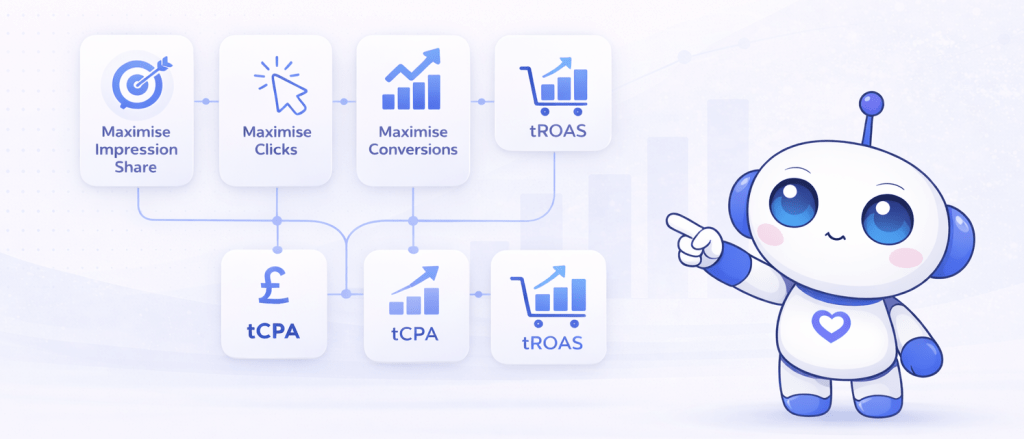
Today, Google Ads offers a range of automated bidding strategies powered by machine learning.
So, which one should you use?
It depends on what you’re trying to achieve.
Quick summary: which bidding strategy should you use?
If you want a simple starting point:
- Brand protection → Maximise Impression Share
- New campaigns / low data → Maximise Clicks
- Lead generation → Maximise Conversions (with tCPA)
- E-commerce (varying order values) → Maximise Conversion Value (with tROAS)
Below is a breakdown of each strategy and when to use it.
Maximise Impression Share
The Maximise Impression Share bidding strategy focuses on visibility.
It allows you to target a specific percentage of available impressions and, if needed, set a maximum CPC bid.
Unlike conversion-based strategies, it does not consider the likelihood of conversion. Instead, it treats all auctions equally and prioritises showing your ads as often as possible.
What is impression share?
Impression share is the percentage of total available impressions your ads receive.
For example, if there are 1,000 relevant searches per day and your ads appear for 600 of them, your impression share is 60%.
When to use it
This strategy is most effective for brand protection.
If competitors are bidding on your brand name, you can aim for close to 100% impression share to ensure your ad appears at the top of search results and captures that traffic.
⚠️ Be cautious:
Using this strategy outside of brand campaigns can lead to wasted spend, as it does not prioritise high-intent users.
Maximise Clicks
Maximise Clicks is designed to generate as much traffic as possible within your budget.
It typically delivers the highest click volume of all automated bidding strategies. However, like impression share bidding, it does not optimise for conversions.
When to use it
1. New campaigns (learning phase)
If your campaign has little or no conversion data, this strategy can help generate traffic and build a data foundation.
Google generally recommends switching to a conversion-focused strategy once you reach around 15 conversions in 30 days.
2. Low conversion volume campaigns
Even established campaigns can lose momentum if conversion data drops. Temporarily switching to Maximise Clicks can help restart the learning phase.
⚠️ Be cautious:
This strategy can attract lower-quality traffic if your targeting isn’t tight.
Maximise Conversions
Maximise Conversions focuses on generating as many conversions as possible within your budget.
Unlike the previous strategies, it uses signals such as user behaviour, intent, demographics, and device to predict conversion likelihood — and adjusts bids accordingly.
This means:
- You may get fewer clicks
- But those clicks are more likely to convert
You may also see higher CPCs if the algorithm identifies high-intent users.
When it works best
This strategy performs best when:
- Conversion tracking is properly set up
- The campaign has at least 15 conversions in the last 30 days
This data allows the algorithm to optimise effectively.
Example
If you run lead generation campaigns (e.g. insurance quotes) and can afford to pay £50 per enquiry, you can use this strategy to maximise lead volume within your budget.
Maximise Conversion Value
Maximise Conversion Value is similar to Maximise Conversions, but instead of focusing on the number of conversions, it focuses on their total value.
In e-commerce, this typically means revenue.
The algorithm prioritises users who are more likely to generate higher-value purchases — not just more purchases.
When to use it
This strategy is ideal when:
- You track revenue accurately
- Order values vary significantly
- You want to maximise total return, not just volume
As with other automated strategies, it performs best with sufficient data (typically 15+ conversions in 30 days).
How to choose the right bidding strategy
The most important decision is often between:
- Maximise Conversions
- Maximise Conversion Value
Start by looking at your profit structure.
If your products range from £5 to £500, ask yourself:
Is a £300 sale significantly more valuable than a £30 sale?
If higher-value orders generate more profit in absolute terms, then Maximise Conversion Value is usually the better choice.
If your business values each conversion similarly (e.g. fixed-value leads), then Maximise Conversions is often more appropriate.
Important clarification
Profit margin should be considered in absolute terms, not just percentages.
Even with a consistent margin (e.g. 20%), a £300 sale generates more profit than a £30 sale — which makes value-based bidding more effective.
Target CPA and Target ROAS
Choosing between these strategies naturally leads to target CPA (tCPA) and target ROAS (tROAS).
These are not separate strategies, but extensions of conversion-based bidding.
Target CPA (tCPA)
tCPA allows you to set the average amount you are willing to pay for a conversion.
This helps guide the algorithm to generate conversions more efficiently while maintaining cost control.
The right tCPA depends on your:
- Profit margins
- Customer value
- Industry benchmarks
Target ROAS (tROAS)
tROAS allows you to define the return you want from your ad spend.
For example, a 300% ROAS means generating £3 in revenue for every £1 spent.
⚠️ Note: ROAS is based on revenue, not profit.
tROAS is particularly useful for e-commerce businesses where order values vary and revenue optimisation is key.
If you want to go deeper into how to set the right targets, read our guide on choosing the right tCPA and tROAS.
Final thoughts
There is no single “best” bidding strategy in PPC.
The right choice depends on:
- Your campaign goals
- Your data volume
- Your business model
Using the wrong strategy can limit performance — even if everything else in your account is set up correctly.
Need help choosing the right strategy?
If your campaigns are generating traffic but not delivering results, your bidding strategy could be the issue.
Request a PPC audit and we’ll show you:
- Whether you’re using the right bidding strategy
- Where your budget is being wasted
- What to change to improve performance


 adripple.co.uk