
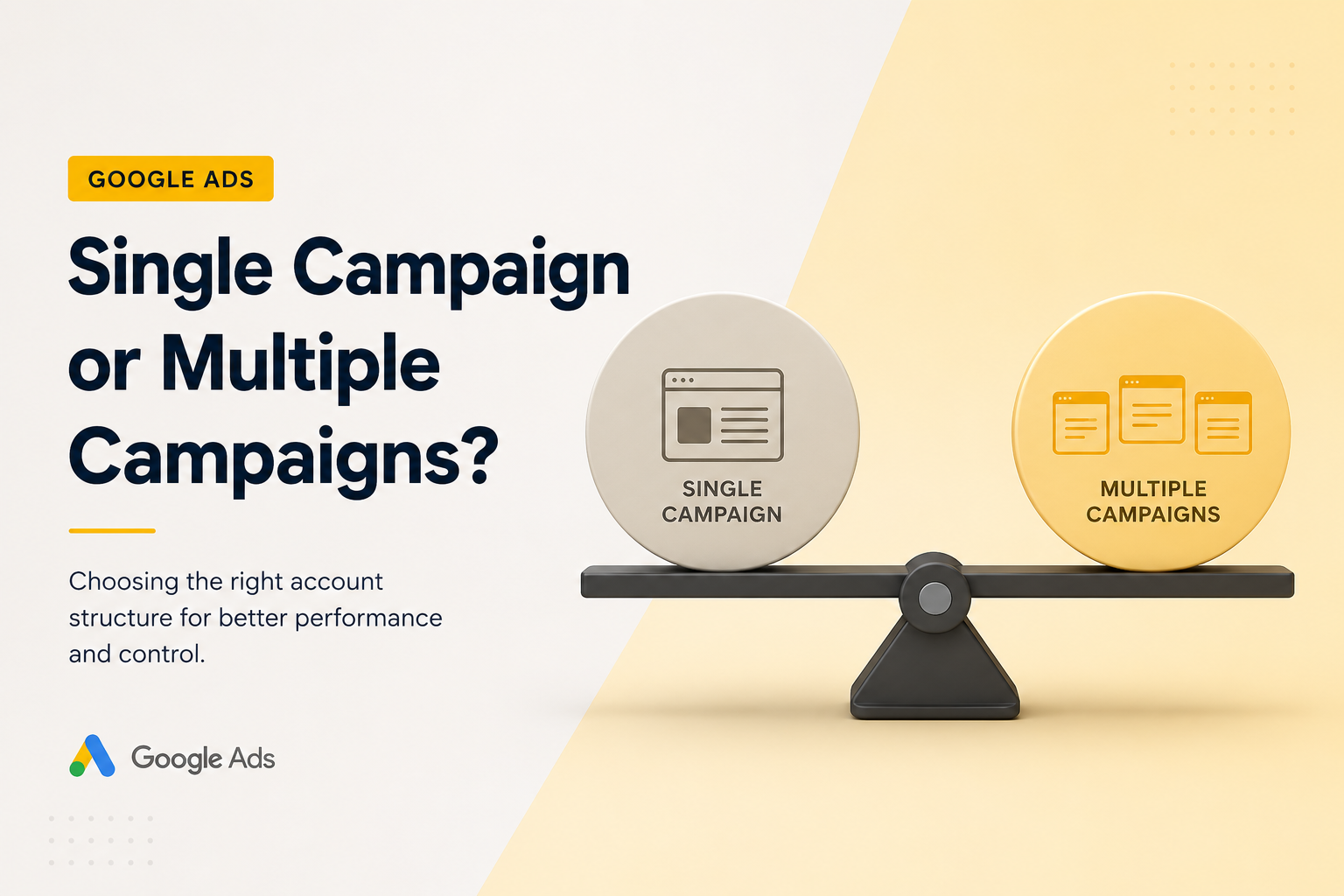
One of the most important decisions when managing a Google Ads account is how to structure your campaigns. Should you consolidate activity into a small number of campaigns to maximise Google’s machine learning, or create a more granular account with separate campaigns for each product or service?
There isn’t a universal right or wrong answer. The best approach depends on factors such as your conversion volume, target audience, budget requirements and overall marketing objectives.
Understanding the strengths and limitations of each strategy can help you build an account that is easier to manage and better positioned for long-term performance.
Consolidated Account Structure
A consolidated account uses fewer campaigns, with multiple products or services grouped together within the same campaign using different ad groups or asset groups.
Google generally recommends consolidating campaigns where possible, as larger datasets give its automated bidding systems more information to learn from. For many accounts, particularly those with lower conversion volumes, this approach can significantly improve bidding performance.
Advantages of Consolidating Campaigns
The biggest advantage is stronger machine learning.
When more conversions are recorded within a single campaign, Google’s bidding algorithms receive more data about the users who are most likely to convert. This often allows Smart Bidding strategies such as Target CPA and Target ROAS to optimise more quickly and produce more stable results.
For newer accounts or businesses with relatively low conversion volumes, consolidating similar products or services can help campaigns reach the data thresholds needed for effective automated bidding.
A simpler account structure can also make day-to-day management easier, reducing unnecessary complexity without sacrificing performance.
Disadvantages of Consolidating Campaigns
The trade-off is reduced control.
Campaign budgets are set at campaign level, so every ad group or asset group within that campaign competes for the same budget. Google’s algorithms decide where that budget is allocated based on predicted performance.
This can become a problem if certain products or services require guaranteed investment. For example, you may want to consistently promote a high-margin service even if Google’s algorithms temporarily favour another area of the campaign.
Search campaigns offer some additional flexibility by allowing different Target CPA or Target ROAS values at ad group level. However, Performance Max campaigns do not provide this level of control, meaning all asset groups operate under the same campaign-level bidding strategy.
Another important consideration is audience similarity.
Consolidation only works well when the products or services appeal to broadly the same type of customer.
Google’s algorithms learn from every conversion they record. If completely different products targeting different audiences are grouped together, that learning becomes less relevant across the campaign. For example, if one product primarily appeals to younger consumers while another targets business decision-makers, combining them may dilute audience signals and reduce overall performance.
In our experience, this is one of the most common account structure mistakes we encounter during PPC audits.
Granular Account Structure
A granular account separates different products, services or business objectives into individual campaigns.
Although this approach creates a more complex account, it provides significantly greater control over budgeting and optimisation.
Advantages of Granular Campaigns
The biggest benefit is flexibility.
Separate campaigns allow you to allocate individual budgets to each product or service based on business priorities rather than allowing Google to decide how spend is distributed.
If one service becomes more profitable, seasonal demand changes or a promotion needs additional investment, adjusting spend is straightforward without affecting the rest of the account.
Granular structures also allow Performance Max campaigns to use different Target ROAS goals for different product categories. Since bidding targets cannot be assigned at asset group level, separate campaigns are often the only practical solution when different profitability targets are required.
Keeping different products or services in separate campaigns also keeps Google’s learning separate. If each campaign targets a distinct audience, Google’s optimisation remains focused on the users most likely to convert for that specific offering rather than attempting to apply one audience profile across everything you advertise.
Disadvantages of Granular Campaigns
The main drawback is reduced learning volume.
Each campaign collects its own conversion data independently. If an account only generates a small number of conversions each month, splitting activity across many campaigns can leave each campaign with insufficient data for Google’s automated bidding strategies to optimise effectively.
For businesses with limited conversion volume, overly granular structures often make campaigns slower to learn and less stable.
As with most aspects of PPC management, greater control usually comes with greater complexity.

How We Decide Which Structure to Use
Rather than following a fixed rule, we usually consider four key questions before deciding on an account structure.
1. How many conversions does the account generate?
Conversion volume is often the deciding factor.
Google generally recommends that automated bidding strategies have a healthy flow of recent conversion data to optimise effectively. If an account generates relatively few conversions, consolidating similar campaigns often improves performance by increasing the amount of learning data available.
Accounts generating strong conversion volumes have much greater flexibility to separate campaigns without negatively affecting machine learning.
2. Do your products or services target different audiences?
This is arguably the most important consideration.
If different products appeal to different demographics, interests, buying behaviours or customer types, they should usually be managed in separate campaigns.
Keeping audience signals separate allows Google’s optimisation to become more accurate over time.
3. Do you need separate budgets?
Some businesses need precise control over how advertising spend is allocated.
For example, you may wish to:
- Prioritise higher-margin services
- Increase investment during seasonal promotions
- Protect spend for key product categories
- Scale individual campaigns independently
Separate campaigns make all of this considerably easier.
4. Do you have dedicated landing pages?
Dedicated landing pages often support a more granular account structure.
If each service or product category has its own highly relevant landing page, creating separate campaigns usually provides greater control over messaging, budgeting and optimisation.
If all traffic ultimately lands on the same page, consolidation may be the more practical option.
Final Thoughts
There is no single “correct” Google Ads account structure.
In many cases, consolidating campaigns improves Google’s ability to learn from conversion data. In others, separating campaigns provides the control needed to maximise profitability and manage budgets effectively.
The most important principle is to avoid combining products or services that target fundamentally different audiences. Beyond that, the ideal structure depends on your business goals, conversion volume and management preferences.
If you’re unsure whether your Google Ads account is structured effectively, an independent PPC audit can quickly identify opportunities to improve campaign performance, budget allocation and long-term scalability.

