
The challenge
Improving efficiency without sacrificing sales
A home and garden e-commerce business approached us with concerns about rising advertising costs and declining account efficiency. Overall ROAS had fallen to around 4.5x, and the objective was to bring it back above 6.1x.
However, improving ROAS by simply cutting advertising spend wasn’t the goal. The client needed to maintain sales volume and revenue while making its advertising investment work harder.
The timing made this particularly challenging. The account was approaching its busiest trading period, when demand and sales opportunities were increasing. Making sweeping changes or launching too much new activity risked disrupting performance at a critical time.
The challenge was to improve returns without sacrificing sales, carefully refining the existing account while building a stronger foundation for sustainable growth.
The approach
Improving control without disrupting performance
With peak season approaching, changes had to improve control and efficiency without unnecessarily disrupting existing campaign performance.
01

Better control over spend
Reduced investment in weaker-performing areas and restructured Performance Max to give individual products greater control over budget allocation.
Shopping-focused PMax · Product prioritisation · Ad group-level targets
02

Improved search traffic
Refined keyword targeting, reviewed search terms and added negatives to reduce wasted spend and help searches reach the right products.
Keyword selection · Search-term reviews · Negative keywords
03

Controlled expansion
Introduced tightly controlled Dynamic Search Ads and adjusted investment around product performance, promotions and seasonal demand.
Product-level performance reviews · Ongoing campaign optimisation
The results
Phase 1 – Restoring efficiency
Q3 2024 ➔ Q1 2025
The first priority was to reverse declining efficiency without undermining sales. By refining campaign structure, improving targeting and reducing investment in weaker-performing areas, the account moved back above its initial ROAS target.

4.53x ➔ 6.49x

ROAS improved by 43.3%, exceeding the initial 6.1x target.

-20.1%

Spend decreased by 20.1% between Q3 2024 and Q1 2025.

+14.6%

Revenue increased by 14.6% between Q3 2024 and Q1 2025.

Phase 2 – Scaling sustainably
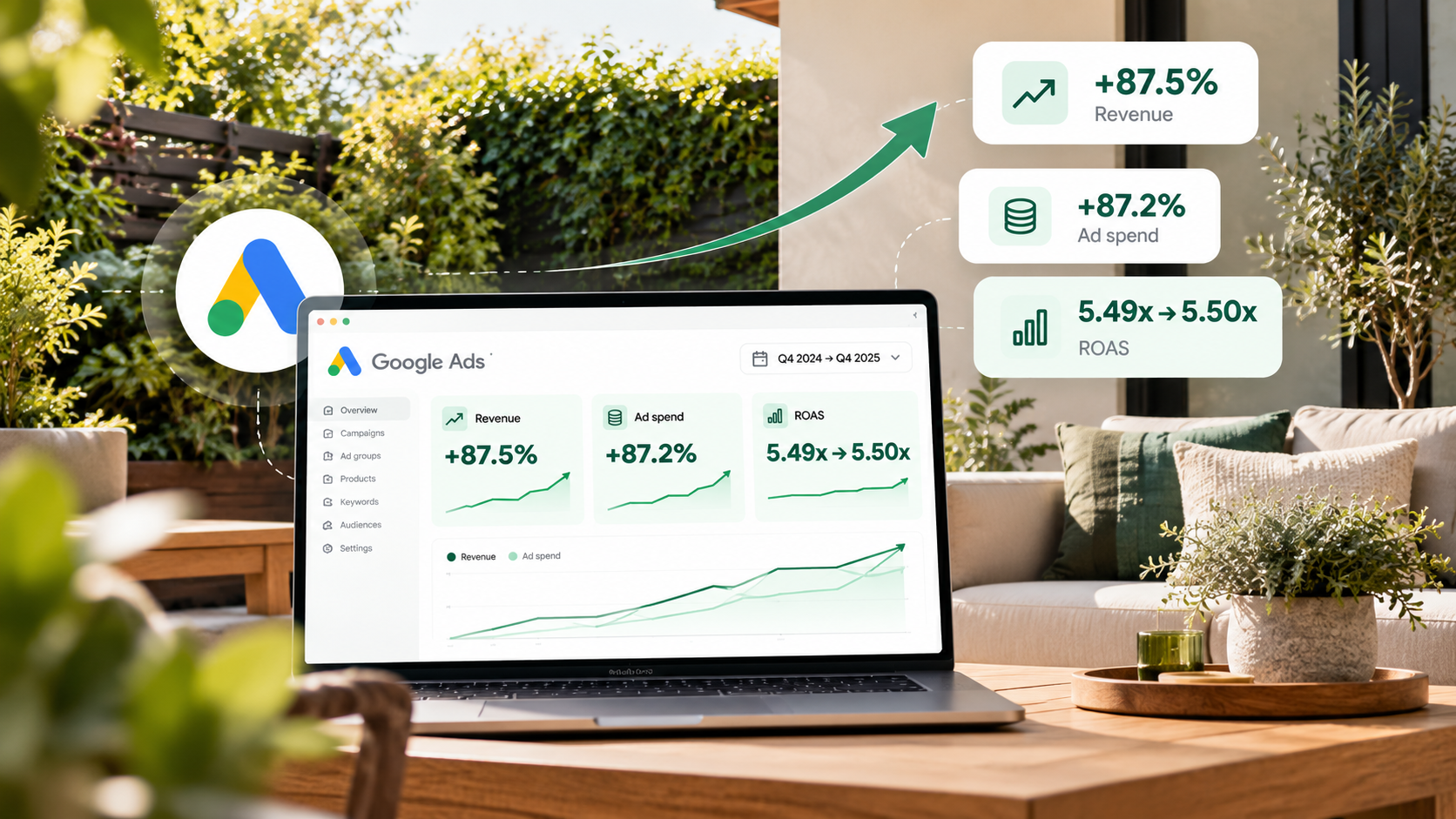
Q4 2024 ➔ Q4 2025
With efficiency restored, the next phase focused on scaling the account. We increased investment to capture more demand and grow revenue, while keeping returns within the revised efficiency target.

+87.5%
£2.38m → £4.47m
Revenue increased by 87.5% between Q4 2024 and Q4 2025.
+87.2%
£434k → £813k
Ad spend increased by 87.2% between Q4 2024 and Q4 2025.

5.49x → 5.50x
Broadly maintained
ROAS held steady at around 5.5x despite increased investment.
how we scaled

Product-level performance control
We prioritised high-performing products and adjusted campaign investment based on their performance.

Promotional bid optimisation
We adapted bids and investment around promotional activity to maximise demand during peak trading periods.

Performance monitoring
We reviewed search negatives and product performance to minimise wasted spend as the account scaled.

Key Takeaways
Restore efficiency before scaling
Refining campaign structure, improving targeting and reducing investment in weaker-performing areas helped improve ROAS while increasing revenue.
Prioritise performance at product level
Monitoring product performance, reviewing search terms and adjusting investment helped direct spend towards stronger opportunities and limit wasted budget.
Scale with clear efficiency targets
Once performance improved, advertising spend could increase substantially while ROAS remained broadly stable – demonstrating the importance of balancing revenue growth with profitability targets.
Ready to get more from your Google Ads budget?
Whether you’re looking to improve campaign efficiency or scale performance sustainably, a more considered PPC strategy can help you make better use of your advertising spend.